 Skip to content

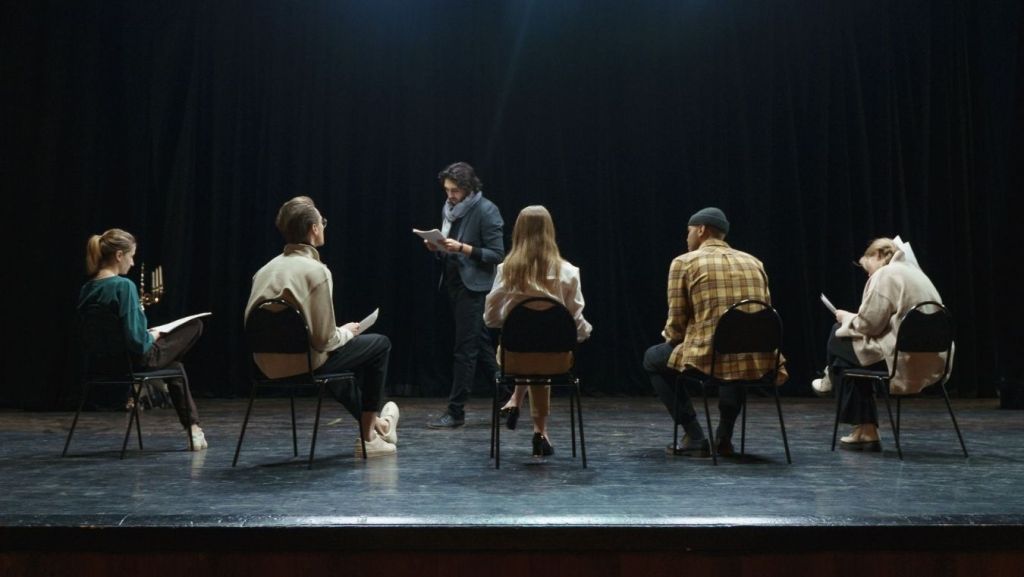
Writing an ensemble cast is one of the hardest structural jobs in storytelling, since you’re managing multiple leads instead of one central character. You love every protagonist equally, but readers can’t always keep pace. Heck, the reader might even get lost by page ten.
This guide provides you with the frameworks to help you manage a full cast without diluting narrative focus.
The Logline
- An ensemble cast gives multiple characters equal narrative weight.
- Most ensembles land best with three to four point-of-view characters.
- A screen time audit grid identifies imbalances in ensemble casts to ensure everyone gets equal attention.
What is an Ensemble Cast (and When Should You Write One)?
An ensemble cast is a story structure in which several characters share equal narrative importance rather than a single lead carrying the whole plot.
Ensemble Cast vs. Multi-POV: Understanding the Difference
The difference between an ensemble cast and a multi-POV show is character prioritization. An ensemble cast is a group of characters who share narrative importance, each one a full protagonist needing equal care. A multi-POV story, on the other hand, keeps one protagonist driving the plot while the other viewpoints only add texture.
| Factor | Ensemble Cast | Multi-POV Story |
|---|---|---|
| Protagonist count | Three or more, equal weight | Usually two, one dominant |
| Common genres | Heist, epic fantasy, TV drama | Romance, thriller |
When Your Story Demands Multiple Protagonists
Four signals point you toward an ensemble cast:
- A single character can’t witness every critical plot event alone.
- Your theme needs contrasting worldviews to land with real weight.
- You think that one lead could result in thin, underwritten side characters.
- Your genre calls for it, like romance, epic fantasy, heist stories, or TV drama.
Ensemble casts fit stories that need multiple witnesses to key events, that contrast worldviews, or that follow genre conventions such as heist, epic fantasy, and TV drama. Dual protagonists show up most in romance novels, with one POV per love interest.
How Should You Structure an Ensemble Cast?
Ensemble stories generally follow one of two structural models, and your point-of-view count matters just as much as the model itself. Neither one changes the story engine running underneath, just how many hands are on the wheel.
The Character Interview Method
Stuck creating a character? Sit down and interview them like a real person. The character interview method uses targeted questions to surface a character’s psychology before you start writing scenes.
Try these five questions when creating your characters:
- What would you never forgive?
- How do you react when someone you love lets you down?
- What’s the first thing you notice walking into a room?
- What’s the lie you tell yourself the most?
- What’s the one thing you’d fix about your world if you could?
Differentiating Dialogue, Worldview, and Emotional Registers
Distinct voice and goal differentiate each character far more than an accent or slang word. Characters need psychological differences too, like how they handle stress or laugh.
Put the following into notes:
- Sentence length and vocabulary range
- What each character notices, as well as what they usually miss
- Their default reaction under pressure; some fight, while others freeze, rationalize, or deflect
Varied dialogue patterns let readers identify each character without a name tag.
Here’s an example template you can use to differentiate characters:
Character Name | Speech Pattern | Default Emotion Under Pressure | Sensory Priority | Worldview Lens |
How Do You Balance Screen Time and Story Arcs Across Multiple Protagonists?
Balancing screen time across multiple protagonists takes a deliberate tracking system.
The Screen Time Audit Grid
When one arc soaks up all the attention, build a grid. The screen time audit grid tracks each character’s page or scene count so no single arc dominates the story, allowing you to distribute screen time proportionally across multiple leads. Novelists can swap acts for chapters and get the same result.
For example:
| Character | Chapter 1 | Chapter 2 | Chapter 3 |
|---|---|---|---|
| Mara | 1,200 | 400 | 900 |
| Dez | 300 | 1,400 | 200 |
See how you can easily track each character’s screen time.
This grid also works for game writers tracking quest lines and comic book writers tracking issue panels.
POV Rotation Formulas That Maintain Momentum
Next, use a screen-time rotation to cover all the main characters. An equal rotation pattern like A, B, C, A, B, C keeps screen time balanced across a true ensemble, while a weighted rotation like A, B, A, C favors one lead character. Either formula maintains audience investment across multiple concurrent arcs.
Staggering Emotional Milestones to Prevent Flat Spots
Every character needs a personal arc, but it may be hard to present this equally and effectively in an ensemble cast. Staggering each character’s emotional milestones prevents flat pacing by spacing out crisis points across the ensemble. So, if Character A hits crisis at the midpoint, push Character B’s crisis before or after.
How Do You Weave Subplots into a Unified Narrative?
Weaving ensemble subplots into a unified narrative means tying every character’s arc back to one shared thematic thread.
Connecting Individual Arcs to a Central Thematic Thread
Ensemble writing needs a unifying core that holds all the arcs together. Say your theme is the cost of loyalty. You could have one character wrestling with loyalty to family. Another character can show loyalty to an institution. The third one could demonstrate loyalty to themselves. That thematic unity should keep every subplot linked.
The Subplot Convergence Checklist
The subplot convergence checklist flags subplot bloat by testing whether each arc ties to the theme and pays off before the final act.
Run this checklist during revision to catch subplot bloat:
- Can you state each subplot’s link to the central theme in one sentence?
- Does each protagonist’s climax affect another protagonist’s journey?
- Do at least two subplots converge at a shared climax before the final act?
- Could you cut any subplot without weakening the theme?
- Does each subplot’s resolution support the main climax?
Tools for Managing Complex Ensemble Manuscripts
Managing a complex ensemble takes dedicated tracking tools, since memory alone can miss too many imbalances.
Story Bibles, Scene Trackers, and Arc Maps
Have the following to keep every arc, scene, and character voice organized:
- A story bible tracks each character’s arc, motivation, relationships, and voice notes. TV showrunners use a series bible on a multi-season show.
- A scene tracker logs POV character, word count, and subplot per scene.
- An arc map plots each journey across the three-act structure.
Screenwriters often build these in Final Draft, WriterDuet, Celtx, Highland, or StudyBinder. Novelists lean on Scrivener for its corkboard and label tools.
Using Script Analysis to Audit Your Ensemble
Script coverage platforms read your full screenplay and provide you with a coverage report, flagging character development, dialogue, pacing, and structure issues. The coverage report gives you a list of sections you can improve to strengthen your ensemble cast.
AI script coverage tools like Greenlight Coverage can deliver you a coverage report within 15 to 60 minutes.
Frequently Asked Questions
What is an ensemble cast in writing?
An ensemble cast is a group of characters who share equal narrative importance, with no single character driving the story. Screen time, character development, and plot are evenly distributed across the group rather than centered on a single protagonist. TV drama, epic fantasy, heist fiction, and literary novels most often use ensemble casts.
How many protagonists can a novel have?
A novel can have two to seven protagonists, and three to four works best for most genres. Eight or more protagonists make a cast difficult for readers to track and for writers to manage. Genre and pacing decide the exact number that fits a story.
How do you balance screen time in an ensemble cast?
Balance screen time in an ensemble cast by tracking each character’s appearances on a grid mapped to chapters or episodes. Pair the grid with a rotation formula, such as A, B, C, A, B, C, to keep exposure even. Adjust the rotation when a subplot needs extra focus.
What is the difference between multi-POV and ensemble cast?
The main difference between multi-POV and an ensemble cast is the number of protagonists. A multi-POV story keeps one clear protagonist and uses other viewpoints only for variety. An ensemble cast splits narrative weight equally across multiple leads, so no single character carries the story alone.
How do you keep readers from getting confused with multiple protagonists?
Keep readers from getting confused with multiple protagonists by giving each character a distinct voice and a consistent POV pattern. Label chapter or section breaks clearly so readers always know who’s speaking. Clarify character relationships early to prevent readers from mixing up the cast.
Can a screenplay have multiple protagonists?
Yes, screenplays can have multiple protagonists, and many successful films use this structure. Avengers splits the lead role across a team of superheroes, and Nashville spreads it across a large ensemble cast. This structure works when each protagonist drives a distinct thread of the plot.
Ready to Stress-Test Your Ensemble Script?
Greenlight Coverage reads your full screenplay and sends back a coverage report in 15 to 60 minutes, built to catch the character, pacing, and dialogue issues ensemble scripts hide best. Upload your draft and get notes like a development executive would, minus the waitlist.