 Skip to content
Discover how to implement and avoid common pitfalls, crafting compelling narratives with ease.
Origins of Dan Harmon’s Circle Theory
Dan Harmon’s Circle Theory, also known as the Story Circle, finds its roots in the broader traditions of myth and storytelling, especially influenced by Joseph Campbell’s monomyth or the Hero’s Journey. Harmon was deeply engrossed in the study of story structure and he sought a practical, simplified method to create engaging narratives. This passion emerged in the late 1990s when he was facing creative hurdles on a project.
Harmon admired Campbell’s work for its comprehensive exploration of myths from various cultures, which highlighted a universal pattern in human storytelling. However, Campbell’s 17-step monomyth appeared too complex and cumbersome for consistent application in scriptwriting and other forms of modern storytelling. Harmon’s solution was to distill these complexities into a manageable, eight-step structure.
Interestingly, the final version of the Story Circle underscores the cyclical nature of stories, an aspect Harmon believed was crucial to their resonance and effectiveness. He referred to the Story Circle as “The Embryo,” symbolizing the natural, evolving process of character transformation within a structured narrative arc. The process begins with a character in their comfort zone and leads them through a journey of change and growth, much like the life cycle captured in ancient myths.
The Story Circle isn’t just a theoretical concept; it’s a practical tool designed to break down complicated plot progressions into something writers can easily reference and apply. For Harmon, it was about creating a cheat sheet that demystified storytelling and embraced its inherent cyclicality. This tool aimed to serve everyone from novice writers to seasoned story architects navigating the tumultuous seas of plot development.
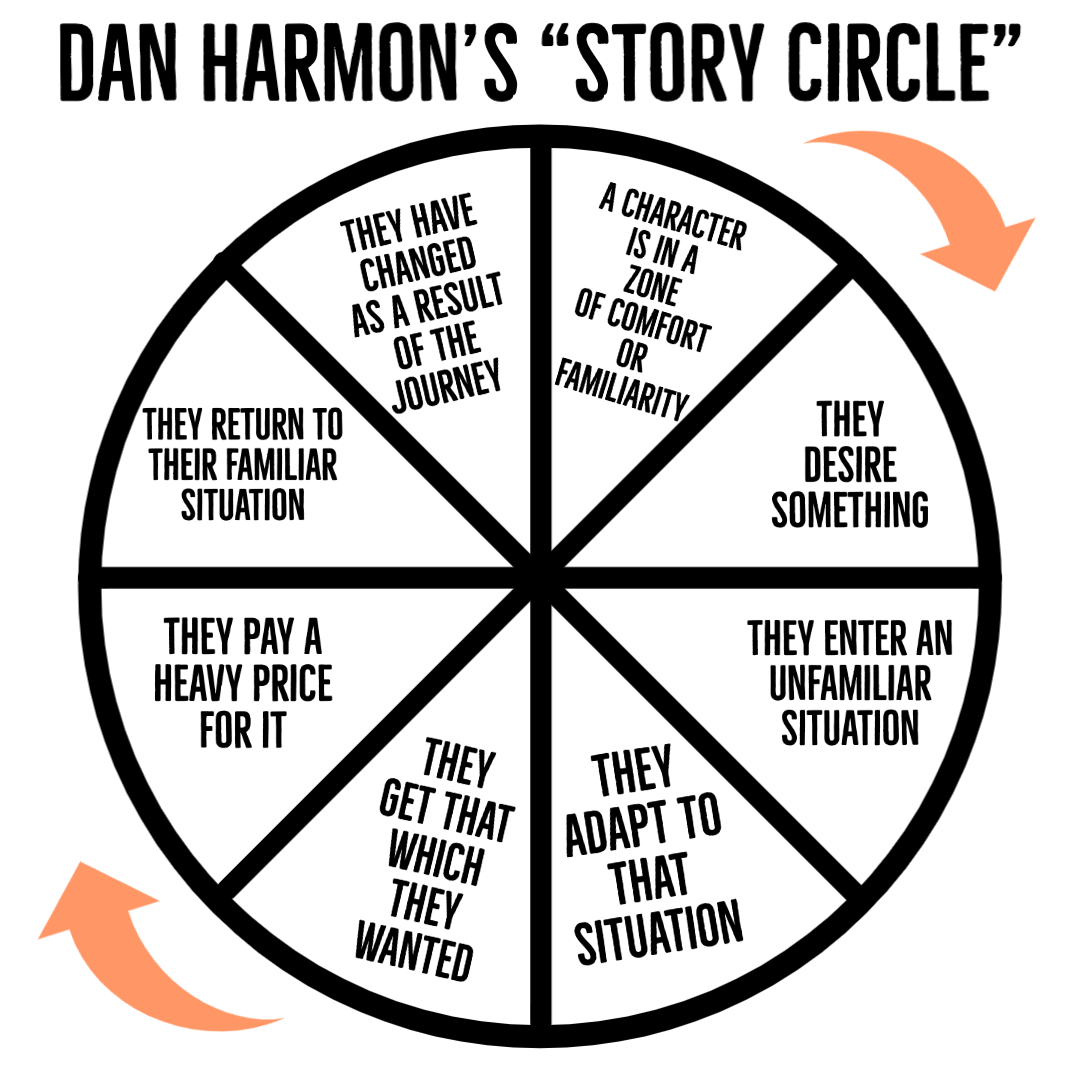
The 8 Steps of Dan Harmon’s Story Circle
Dan Harmon’s Story Circle comprises eight distinct stages, each representing a crucial point in the character’s journey. These steps are designed to guide both the plot and character development in a cohesive and impactful manner. Let’s delve into each stage and understand its role:
- You: This step introduces the protagonist in their comfort zone. We get to know who they are, what their world looks like, and why we should care about them. This is the baseline from which the journey begins.
- Need: Here, the protagonist becomes aware of a need or a desire—a goal that propels them out of their comfort zone. This want creates the initial tension and sets the story in motion.
- Go: The protagonist leaves their familiar environment and ventures into an unknown situation. This transition marks the beginning of Act II, where the character steps into the realm of adventure and uncertainty.
- Search: As the journey unfolds, the protagonist faces challenges and learns to navigate this new world. This step is critical for character development as they adapt and grow in response to their experiences.
- Find: At this midpoint, the protagonist obtains what they were seeking. However, achieving their goal often comes with unexpected consequences or revelations that add depth to the narrative.For a deeper dive into these steps, you can explore Reedsy’s guide.
- Take: Success and its price become apparent here. The protagonist gains what they needed but at a significant cost, which introduces complexity and often a moral dilemma or personal sacrifice.
- Return: With the goal achieved and the cost paid, the protagonist begins their journey back to their familiar world, equipped with new wisdom and experiences.
- Change: Finally, the protagonist returns to their initial setting, but they’ve changed fundamentally. The journey has altered them in ways that prepare them for future challenges or deeper understanding.
These eight steps encapsulate the essence of Dan Harmon’s Circle Theory, making it an invaluable tool for storytellers aiming to create compelling and well-structured narratives.
How Dan Harmon’s Story Circle Facilitates Better Storytelling
Implementing Dan Harmon’s Heros Journey Circle Theory offers several distinct advantages that enhance storytelling across various mediums.
Consistent Plot Development
First, the Story Circle provides a clear roadmap, ensuring that each plot point aligns with the overall narrative arc. By meticulously following the eight steps, you can maintain a coherent storyline that naturally progresses from one stage to another. This consistency helps in avoiding plot holes and ensures that the story flows smoothly, keeping the audience engaged from start to finish.
Strong Character Arcs
One of the standout features of the Story Circle is its focus on character transformation. By emphasizing the protagonist’s journey and the changes they undergo, you can create deep, relatable characters. Audiences are more likely to connect with a character who evolves in meaningful ways, making the emotional stakes higher and the narrative more impactful.
Maintaining Audience Interest
The cyclic structure of the Story Circle naturally builds and releases tension, keeping viewers or readers hooked. Each step introduces new conflicts or revelations that drive the story forward, ensuring that there’s always a reason to keep watching or reading. This regular ebb and flow of tension and resolution is key to maintaining audience interest.
For more practical benefits, visit this Boords blog post.
Cross-Genre Applicability
Whether you’re crafting a comedy series or a dramatic novel, the Story Circle’s versatile framework can be applied to any genre. Its universal principles of desire, conflict, and transformation resonate with diverse audiences, making it a reliable tool for all storytellers.
By leveraging these benefits, Dan Harmon’s Circle Theory can significantly enhance the quality and effectiveness of your storytelling.
Application of the Story Circle in Different Media
Dan Harmon’s Circle Theory isn’t confined to just one type of storytelling. Its flexibility makes it applicable across various media, including films, TV shows, novels, and even video games. Let’s explore how this versatile framework can adapt to different storytelling forms.
Films
In films, the Story Circle provides a robust skeleton for plot and character development. Take the Harry Potter series, for instance. Each movie follows a cyclical structure where the protagonist starts in a comfort zone, faces challenges, adapts, achieves goals, and ultimately undergoes significant growth. This adherence to the Story Circle ensures a seamless narrative that keeps viewers engaged from start to finish.
TV Shows
Dan Harmon himself uses the Story Circle extensively in his work on TV shows like “Rick and Morty.” Each episode effectively employs the eight-step structure to deliver captivating and well-rounded stories. Whether it’s a comedic plot or a more serious episode, the Story Circle helps maintain narrative cohesion and character continuity across episodes and seasons.
Novels
For novelists, the Story Circle can be a valuable tool in structuring complex narratives. Unlike films or TV shows, novels often delve deeper into internal character struggles and elaborate plotlines. By using the Story Circle, authors can ensure that each chapter aligns with the protagonist’s overall journey, maintaining narrative consistency and character growth throughout the book.
Video Games
In the realm of video games, where players actively participate in the narrative, the Story Circle can enhance the gaming experience. Games like “The Legend of Zelda” series exemplify the Story Circle’s principles, guiding players through a hero’s journey that involves challenges, growth, and transformation. This structure not only enriches the storytelling but also makes the gameplay more engaging and rewarding.
To explore more examples of the Story Circle in different media, check out Industrial Scripts.
The versatility of Dan Harmon’s Circle Theory makes it an invaluable tool across various storytelling platforms, ensuring compelling and well-rounded narratives.
Dan Harmon’s Story Circle vs. Traditional Story Structure Theories
When it comes to story structure, there are several popular theories, each with its own strengths and weaknesses. Dan Harmon’s Story Circle offers a refreshing alternative to traditional models like the Three-Act Structure and Joseph Campbell’s Hero’s Journey. Let’s explore how these frameworks compare and why you might choose one over the others.
The Hero’s Journey

Joseph Campbell’s Hero’s Journey is perhaps the most well-known story structure. With its 17 stages, it provides a comprehensive blueprint for epic tales of heroism and adventure. While its depth and detail make it excellent for in-depth storytelling, its complexity can be overwhelming for writers aiming for more straightforward narratives.
The Three-Act Structure
The Three-Act Structure is another widely-used framework, often employed in screenwriting. It divides the story into three main sections: Setup, Confrontation, and Resolution. While this structure is simple and effective, it sometimes lacks the detailed character focus provided by the Story Circle.
How the Story Circle Stands Out
Dan Harmon’s Circle Theory distills the essence of these complex models into a more digestible, eight-step process. This simplicity allows writers to focus on both plot progression and character development without getting bogged down by intricate details.
- Simplicity: With only eight steps, the Story Circle is easier to grasp and apply, making it accessible to writers at all levels.
- Focus on Transformation: The emphasis on character change ensures that the protagonist’s journey is central to the narrative, enhancing emotional depth.
- Cyclical Nature: Unlike the linear progression of the Three-Act Structure, the Story Circle’s cyclic approach mirrors the natural ebb and flow of real-life experiences.
For a more in-depth comparison, you can read this article.
Understanding the distinctions between these story structures empowers you to choose the framework that best suits your narrative needs, ensuring a more compelling and well-rounded story.
Why Use Dan Harmon’s Story Circle?
Dan Harmon’s Story Circle offers many practical advantages for writers and storytellers. It’s a framework that combines simplicity with depth, making the storytelling process both efficient and effective.
Efficiency and Intuitiveness
First key idea: The eight-step structure is straightforward and easy to remember, simplifying the complex process of plot development. This ease of use allows writers to focus more on creativity rather than getting bogged down by intricate planning.
Second key idea: It’s intuitive: The cyclical nature of the Story Circle mirrors real-life experiences and transformations, making it easier for both writers and audiences to connect with the narrative. The steps naturally flow from one to the next, providing a clear roadmap from the story’s beginning to end.
Versatile Across Formats
First key idea: The Story Circle is not limited to a single medium. Whether you’re writing a screenplay, a novel, a television episode, or even a video game, the Circle’s structure can be adapted to suit your needs. This versatility ensures that you can maintain a consistent narrative quality across various formats.
Second key idea: Balancing Plot and Character: The Story Circle ensures that character development is as important as plot advancement. Each step prompts you to think about how the protagonist evolves, making your characters more relatable and your story more engaging.
Strong Emotional Impact
Stories constructed using Dan Harmon’s Circle Theory often achieve a heightened emotional impact. By focusing on the protagonist’s transformation and the significant costs associated with achieving their goals, the framework helps craft compelling, emotionally resonant stories. Boords highlights how this cyclical structure keeps audiences invested by constantly raising stakes and delivering a satisfying resolution.
Story Circle Examples in Popular Media
Dan Harmon’s Story Circle has been successfully employed in various well-known films and TV shows, illustrating its effectiveness and versatility.
Movies
First key idea: Harry Potter Series: Each film follows a similar structure where Harry starts in a comfort zone, faces monumental challenges, gains new abilities or knowledge, often at significant personal cost, and returns changed from his experiences.

Second key idea: Taken: In the movie “Taken,” the protagonist begins in his familiar life, faces the traumatic event of his daughter’s kidnapping, embarks on a dangerous mission to rescue her, and by the end, he is transformed by his ordeal. This narrative precisely follows the eight-step structure of Harmon’s Circle.
Television Shows
First key idea: Rick and Morty: Dan Harmon employs his own Circle Theory extensively in “Rick and Morty.” Each episode often starts with the duo in their comfort zone, they encounter a problem or desire, traverse through extraordinary and often bizarre landscapes, face challenges, and ultimately return to their familiar lives, changed in some way.
Second key idea: Community: Another of Harmon’s creations, “Community,” also utilizes the Story Circle. The show effectively balances comedic elements with poignant character development by adhering to this narrative framework.
Novels and Video Games
First key idea: In novels, the Story Circle helps keep longer, more intricate plots manageable. By breaking the story into eight digestible steps, authors can ensure that their characters undergo meaningful growth while maintaining a cohesive narrative thread throughout the book.
Second key idea: Video Games: For interactive storytelling, such as in video games, the Story Circle guides player engagement through well-structured missions and character arcs. Games like “The Legend of Zelda” follow a hero’s journey that aligns closely with Harmon’s methods, making the gameplay experience deeply compelling.
Implementing Dan Harmon’s Story Circle: A Step-by-Step Worksheet
Harnessing the power of the Story Circle for your own projects involves a concentrated approach. Here is a step-by-step process to integrate this framework into your storytelling.
Step 1: Outline the Stages
Start by mapping out the eight stages of the Story Circle: You, Need, Go, Search, Find, Take, Return, and Change. For each stage, jot down initial ideas that fit your story’s premise and characters. This initial outline will serve as your narrative roadmap.
Step 2: Develop Your Protagonist
Ensure your protagonist is well-defined at the outset (You). Clarify what they want (Need) and why it’s essential for them to step out of their comfort zone (Go). This foundational work will inform subsequent stages and deepen character engagement.
Step 3: Plot Conflicts and Challenges
In the Search and Find stages, create scenarios that force your protagonist to adapt and grow. Identify the obstacles they will face and how these challenges reveal different aspects of their character. Make sure these conflicts are compelling and enhance the story’s tension.
Step 4: Highlight the Costs
During the Take stage, show the cost of your protagonist’s success. This step is crucial for emotional impact. Whether it’s a physical, emotional, or moral cost, detailing what the protagonist sacrifices or endures adds weight to their journey.
Step 5: Conclude with Change
Finally, in the Return and Change stages, bring your protagonist back to their starting environment. Show how they have transformed. This closure not only wraps up your narrative neatly but also underscores the significance of their journey. For a more detailed guide, this Boords blog post offers additional insights.
Common Pitfalls and How to Avoid Them
Implementing Dan Harmon’s Story Circle is highly effective, but it comes with common pitfalls. Awareness and strategic planning can help you avoid these mistakes.
Overemphasis on Plot
One major pitfall is focusing too much on the plot at the expense of character development. Each of the eight steps should not only drive the story forward but also deepen the audience’s understanding of the protagonist. Always balance plot progression with moments that reveal character depth and growth.
Rigidity
Another mistake is adhering too rigidly to the structure. While the Story Circle provides a blueprint, it should guide, not constrain, your creativity. Allow flexibility within each step to ensure the narrative feels natural and not forced.
Ignoring Emotional Stakes
The cost or price element (Take) can often be understated. This step is vital for emotional resonance. Ensure that the protagonist’s sacrifices or changes are profound and felt deeply by the audience. This emotional weight increases the impact and memorability of your story.
Conclusion: Embracing Dan Harmon’s Circle Theory of Story
Dan Harmon’s Circle Theory of Story offers a streamlined yet powerful framework for crafting compelling stories. By focusing on both plot development and character transformation, the Story Circle ensures that your narrative is engaging and emotionally resonant.
Balance and Consistency: This narrative tool provides balance and consistency, ensuring that each part of your story contributes meaningfully to the whole.
Emotional Depth: By highlighting the protagonist’s journey and the costs associated with it, the framework helps create stories that resonate deeply with audiences.
Whether you are a novice writer or an experienced storyteller, embracing Dan Harmon’s Story Circle can significantly enhance your storytelling craft. Its adaptability across various media and genres makes it a versatile tool for any narrative endeavor.

Dan Harmon’s Circle Theory, or the Story Circle, is a Heros Journey narrative framework made up of eight distinct steps. These steps—You, Need, Go, Search, Find, Take, Return, Change—guide the character through a transformative journey. It’s a simplified version of the Hero’s Journey, designed to ensure consistent character development and plot progression.
In this article, you’ll explore:
- The origins of the Story Circle
- Each of the eight steps
- How it enhances storytelling across mediums
- Story circle examples and
Discover how to implement and avoid common pitfalls, crafting compelling narratives with ease.
Origins of Dan Harmon’s Circle Theory
Dan Harmon’s Circle Theory, also known as the Story Circle, finds its roots in the broader traditions of myth and storytelling, especially influenced by Joseph Campbell’s monomyth or the Hero’s Journey. Harmon was deeply engrossed in the study of story structure and he sought a practical, simplified method to create engaging narratives. This passion emerged in the late 1990s when he was facing creative hurdles on a project.
Harmon admired Campbell’s work for its comprehensive exploration of myths from various cultures, which highlighted a universal pattern in human storytelling. However, Campbell’s 17-step monomyth appeared too complex and cumbersome for consistent application in scriptwriting and other forms of modern storytelling. Harmon’s solution was to distill these complexities into a manageable, eight-step structure.
Interestingly, the final version of the Story Circle underscores the cyclical nature of stories, an aspect Harmon believed was crucial to their resonance and effectiveness. He referred to the Story Circle as “The Embryo,” symbolizing the natural, evolving process of character transformation within a structured narrative arc. The process begins with a character in their comfort zone and leads them through a journey of change and growth, much like the life cycle captured in ancient myths.
The Story Circle isn’t just a theoretical concept; it’s a practical tool designed to break down complicated plot progressions into something writers can easily reference and apply. For Harmon, it was about creating a cheat sheet that demystified storytelling and embraced its inherent cyclicality. This tool aimed to serve everyone from novice writers to seasoned story architects navigating the tumultuous seas of plot development.
The 8 Steps of Dan Harmon’s Story Circle
Dan Harmon’s Story Circle comprises eight distinct stages, each representing a crucial point in the character’s journey. These steps are designed to guide both the plot and character development in a cohesive and impactful manner. Let’s delve into each stage and understand its role:
- You: This step introduces the protagonist in their comfort zone. We get to know who they are, what their world looks like, and why we should care about them. This is the baseline from which the journey begins.
- Need: Here, the protagonist becomes aware of a need or a desire—a goal that propels them out of their comfort zone. This want creates the initial tension and sets the story in motion.
- Go: The protagonist leaves their familiar environment and ventures into an unknown situation. This transition marks the beginning of Act II, where the character steps into the realm of adventure and uncertainty.
- Search: As the journey unfolds, the protagonist faces challenges and learns to navigate this new world. This step is critical for character development as they adapt and grow in response to their experiences.
- Find: At this midpoint, the protagonist obtains what they were seeking. However, achieving their goal often comes with unexpected consequences or revelations that add depth to the narrative.For a deeper dive into these steps, you can explore Reedsy’s guide.
- Take: Success and its price become apparent here. The protagonist gains what they needed but at a significant cost, which introduces complexity and often a moral dilemma or personal sacrifice.
- Return: With the goal achieved and the cost paid, the protagonist begins their journey back to their familiar world, equipped with new wisdom and experiences.
- Change: Finally, the protagonist returns to their initial setting, but they’ve changed fundamentally. The journey has altered them in ways that prepare them for future challenges or deeper understanding.
These eight steps encapsulate the essence of Dan Harmon’s Circle Theory, making it an invaluable tool for storytellers aiming to create compelling and well-structured narratives.
How Dan Harmon’s Story Circle Facilitates Better Storytelling
Implementing Dan Harmon’s Heros Journey Circle Theory offers several distinct advantages that enhance storytelling across various mediums.
Consistent Plot Development
First, the Story Circle provides a clear roadmap, ensuring that each plot point aligns with the overall narrative arc. By meticulously following the eight steps, you can maintain a coherent storyline that naturally progresses from one stage to another. This consistency helps in avoiding plot holes and ensures that the story flows smoothly, keeping the audience engaged from start to finish.
Strong Character Arcs
One of the standout features of the Story Circle is its focus on character transformation. By emphasizing the protagonist’s journey and the changes they undergo, you can create deep, relatable characters. Audiences are more likely to connect with a character who evolves in meaningful ways, making the emotional stakes higher and the narrative more impactful.
Maintaining Audience Interest
The cyclic structure of the Story Circle naturally builds and releases tension, keeping viewers or readers hooked. Each step introduces new conflicts or revelations that drive the story forward, ensuring that there’s always a reason to keep watching or reading. This regular ebb and flow of tension and resolution is key to maintaining audience interest.
For more practical benefits, visit this Boords blog post.
Cross-Genre Applicability
Whether you’re crafting a comedy series or a dramatic novel, the Story Circle’s versatile framework can be applied to any genre. Its universal principles of desire, conflict, and transformation resonate with diverse audiences, making it a reliable tool for all storytellers.
By leveraging these benefits, Dan Harmon’s Circle Theory can significantly enhance the quality and effectiveness of your storytelling.
Application of the Story Circle in Different Media
Dan Harmon’s Circle Theory isn’t confined to just one type of storytelling. Its flexibility makes it applicable across various media, including films, TV shows, novels, and even video games. Let’s explore how this versatile framework can adapt to different storytelling forms.
Films
In films, the Story Circle provides a robust skeleton for plot and character development. Take the Harry Potter series, for instance. Each movie follows a cyclical structure where the protagonist starts in a comfort zone, faces challenges, adapts, achieves goals, and ultimately undergoes significant growth. This adherence to the Story Circle ensures a seamless narrative that keeps viewers engaged from start to finish.
TV Shows
Dan Harmon himself uses the Story Circle extensively in his work on TV shows like “Rick and Morty.” Each episode effectively employs the eight-step structure to deliver captivating and well-rounded stories. Whether it’s a comedic plot or a more serious episode, the Story Circle helps maintain narrative cohesion and character continuity across episodes and seasons.
Novels
For novelists, the Story Circle can be a valuable tool in structuring complex narratives. Unlike films or TV shows, novels often delve deeper into internal character struggles and elaborate plotlines. By using the Story Circle, authors can ensure that each chapter aligns with the protagonist’s overall journey, maintaining narrative consistency and character growth throughout the book.
Video Games
In the realm of video games, where players actively participate in the narrative, the Story Circle can enhance the gaming experience. Games like “The Legend of Zelda” series exemplify the Story Circle’s principles, guiding players through a hero’s journey that involves challenges, growth, and transformation. This structure not only enriches the storytelling but also makes the gameplay more engaging and rewarding.
To explore more examples of the Story Circle in different media, check out Industrial Scripts.
The versatility of Dan Harmon’s Circle Theory makes it an invaluable tool across various storytelling platforms, ensuring compelling and well-rounded narratives.
Dan Harmon’s Story Circle vs. Traditional Story Structure Theories
When it comes to story structure, there are several popular theories, each with its own strengths and weaknesses. Dan Harmon’s Story Circle offers a refreshing alternative to traditional models like the Three-Act Structure and Joseph Campbell’s Hero’s Journey. Let’s explore how these frameworks compare and why you might choose one over the others.
The Hero’s Journey
Joseph Campbell’s Hero’s Journey is perhaps the most well-known story structure. With its 17 stages, it provides a comprehensive blueprint for epic tales of heroism and adventure. While its depth and detail make it excellent for in-depth storytelling, its complexity can be overwhelming for writers aiming for more straightforward narratives.
The Three-Act Structure
The Three-Act Structure is another widely-used framework, often employed in screenwriting. It divides the story into three main sections: Setup, Confrontation, and Resolution. While this structure is simple and effective, it sometimes lacks the detailed character focus provided by the Story Circle.
How the Story Circle Stands Out
Dan Harmon’s Circle Theory distills the essence of these complex models into a more digestible, eight-step process. This simplicity allows writers to focus on both plot progression and character development without getting bogged down by intricate details.
- Simplicity: With only eight steps, the Story Circle is easier to grasp and apply, making it accessible to writers at all levels.
- Focus on Transformation: The emphasis on character change ensures that the protagonist’s journey is central to the narrative, enhancing emotional depth.
- Cyclical Nature: Unlike the linear progression of the Three-Act Structure, the Story Circle’s cyclic approach mirrors the natural ebb and flow of real-life experiences.
For a more in-depth comparison, you can read this article.
Understanding the distinctions between these story structures empowers you to choose the framework that best suits your narrative needs, ensuring a more compelling and well-rounded story.
Why Use Dan Harmon’s Story Circle?
Dan Harmon’s Story Circle offers many practical advantages for writers and storytellers. It’s a framework that combines simplicity with depth, making the storytelling process both efficient and effective.
Efficiency and Intuitiveness
First key idea: The eight-step structure is straightforward and easy to remember, simplifying the complex process of plot development. This ease of use allows writers to focus more on creativity rather than getting bogged down by intricate planning.
Second key idea: It’s intuitive: The cyclical nature of the Story Circle mirrors real-life experiences and transformations, making it easier for both writers and audiences to connect with the narrative. The steps naturally flow from one to the next, providing a clear roadmap from the story’s beginning to end.
Versatile Across Formats
First key idea: The Story Circle is not limited to a single medium. Whether you’re writing a screenplay, a novel, a television episode, or even a video game, the Circle’s structure can be adapted to suit your needs. This versatility ensures that you can maintain a consistent narrative quality across various formats.
Second key idea: Balancing Plot and Character: The Story Circle ensures that character development is as important as plot advancement. Each step prompts you to think about how the protagonist evolves, making your characters more relatable and your story more engaging.
Strong Emotional Impact
Stories constructed using Dan Harmon’s Circle Theory often achieve a heightened emotional impact. By focusing on the protagonist’s transformation and the significant costs associated with achieving their goals, the framework helps craft compelling, emotionally resonant stories. Boords highlights how this cyclical structure keeps audiences invested by constantly raising stakes and delivering a satisfying resolution.
Story Circle Examples in Popular Media
Dan Harmon’s Story Circle has been successfully employed in various well-known films and TV shows, illustrating its effectiveness and versatility.
Movies
First key idea: Harry Potter Series: Each film follows a similar structure where Harry starts in a comfort zone, faces monumental challenges, gains new abilities or knowledge, often at significant personal cost, and returns changed from his experiences.
Second key idea: Taken: In the movie “Taken,” the protagonist begins in his familiar life, faces the traumatic event of his daughter’s kidnapping, embarks on a dangerous mission to rescue her, and by the end, he is transformed by his ordeal. This narrative precisely follows the eight-step structure of Harmon’s Circle.
Television Shows
First key idea: Rick and Morty: Dan Harmon employs his own Circle Theory extensively in “Rick and Morty.” Each episode often starts with the duo in their comfort zone, they encounter a problem or desire, traverse through extraordinary and often bizarre landscapes, face challenges, and ultimately return to their familiar lives, changed in some way.
Second key idea: Community: Another of Harmon’s creations, “Community,” also utilizes the Story Circle. The show effectively balances comedic elements with poignant character development by adhering to this narrative framework.
Novels and Video Games
First key idea: In novels, the Story Circle helps keep longer, more intricate plots manageable. By breaking the story into eight digestible steps, authors can ensure that their characters undergo meaningful growth while maintaining a cohesive narrative thread throughout the book.
Second key idea: Video Games: For interactive storytelling, such as in video games, the Story Circle guides player engagement through well-structured missions and character arcs. Games like “The Legend of Zelda” follow a hero’s journey that aligns closely with Harmon’s methods, making the gameplay experience deeply compelling.
Implementing Dan Harmon’s Story Circle: A Step-by-Step Worksheet
Harnessing the power of the Story Circle for your own projects involves a concentrated approach. Here is a step-by-step process to integrate this framework into your storytelling.
Step 1: Outline the Stages
Start by mapping out the eight stages of the Story Circle: You, Need, Go, Search, Find, Take, Return, and Change. For each stage, jot down initial ideas that fit your story’s premise and characters. This initial outline will serve as your narrative roadmap.
Step 2: Develop Your Protagonist
Ensure your protagonist is well-defined at the outset (You). Clarify what they want (Need) and why it’s essential for them to step out of their comfort zone (Go). This foundational work will inform subsequent stages and deepen character engagement.
Step 3: Plot Conflicts and Challenges
In the Search and Find stages, create scenarios that force your protagonist to adapt and grow. Identify the obstacles they will face and how these challenges reveal different aspects of their character. Make sure these conflicts are compelling and enhance the story’s tension.
Step 4: Highlight the Costs
During the Take stage, show the cost of your protagonist’s success. This step is crucial for emotional impact. Whether it’s a physical, emotional, or moral cost, detailing what the protagonist sacrifices or endures adds weight to their journey.
Step 5: Conclude with Change
Finally, in the Return and Change stages, bring your protagonist back to their starting environment. Show how they have transformed. This closure not only wraps up your narrative neatly but also underscores the significance of their journey. For a more detailed guide, this Boords blog post offers additional insights.
Common Pitfalls and How to Avoid Them
Implementing Dan Harmon’s Story Circle is highly effective, but it comes with common pitfalls. Awareness and strategic planning can help you avoid these mistakes.
Overemphasis on Plot
One major pitfall is focusing too much on the plot at the expense of character development. Each of the eight steps should not only drive the story forward but also deepen the audience’s understanding of the protagonist. Always balance plot progression with moments that reveal character depth and growth.
Rigidity
Another mistake is adhering too rigidly to the structure. While the Story Circle provides a blueprint, it should guide, not constrain, your creativity. Allow flexibility within each step to ensure the narrative feels natural and not forced.
Ignoring Emotional Stakes
The cost or price element (Take) can often be understated. This step is vital for emotional resonance. Ensure that the protagonist’s sacrifices or changes are profound and felt deeply by the audience. This emotional weight increases the impact and memorability of your story.
Conclusion: Embracing Dan Harmon’s Circle Theory of Story
Dan Harmon’s Circle Theory of Story offers a streamlined yet powerful framework for crafting compelling stories. By focusing on both plot development and character transformation, the Story Circle ensures that your narrative is engaging and emotionally resonant.
Balance and Consistency: This narrative tool provides balance and consistency, ensuring that each part of your story contributes meaningfully to the whole.
Emotional Depth: By highlighting the protagonist’s journey and the costs associated with it, the framework helps create stories that resonate deeply with audiences.
Whether you are a novice writer or an experienced storyteller, embracing Dan Harmon’s Story Circle can significantly enhance your storytelling craft. Its adaptability across various media and genres makes it a versatile tool for any narrative endeavor.
You must be logged in to post a comment.