 Skip to content
It’s the spookiest time of the year! While most people are looking for a good scare, we’re looking for a good screenplay. This Halloween, watch one of these three films, from a timeless horror classic to a much-discussed new release, and analyze what makes the screenplay truly terrifying and captivating.
Here’s what screenwriters can learn from Heretic (2024), The Shining (1980), and Beetlejuice (1988 and 2024).
1. Blending Philosophy and Fear in Heretic (2024)

⚠️ SPOILER ALERT: The following section discusses major plot twists and the ending of the Heretic screenplay. Stop reading now if you want to avoid spoilers before watching the movie.
The script for HERETIC (2024), which received a Recommend from us with an 8.5/10 Overall Rating, is a great example of a contemporary psychological thriller that uses heavy thematic elements to increase the tension. The logline alone sets up a terrifying premise: Two young Mormon missionaries find themselves trapped in the home of a mysterious man who claims to have discovered “The One True Religion” through repeatedly killing and resurrecting his wife.
Thematic Depth as a Weapon
This screenplay proves that high-level philosophical or religious concepts can be woven directly into the narrative structure to ramp up the stakes and suspense.
- Deep Character Dynamics: The script creates strong emotional investment through the relationship between the two main characters: Sister Barnes (the skeptic) and Sister Paxton (the believer). This dynamic gives the philosophical debate a personal, emotional weight.
💡For Screenwriters: Well-developed protagonist dynamics provide multiple perspectives on the main themes (faith, doubt, survival) and drive the conflict.
- High-Concept Originality: The screenplay successfully combines a few familiar elements (horror, thriller) with religious discourse and an original simulation theory angle.
💡For Screenwriters: Use unique philosophical angles to add an interesting and original layer to a known genre.
- Ambiguous Ending as Thematic Conclusion: The script ends with Sister Paxton’s escape and a butterfly landing on her fingertip, leaving it ambiguous whether the sign is from God, her dead companion, or evidence of a simulation.
💡For Screenwriters: Ambiguity can serve the script’s larger themes (like the uncertainty of faith and the human search for meaning) and encourage deep audience discussion—as long as it feels earned and not frustrating.
Even though this screenplay earned a strong Overall Rating of 8.5/10 from us, it has specific areas that could be further improved. Let’s see what we got here:
Plot Assessment and Enhancement
What’s working well in our opinion
Strong Premise and Hook: The story is engaging and thought-provoking due to its unique blend of religious discourse, psychological horror, and philosophical questions.
Complex Characters: The dynamic between Barnes (the skeptic) and Paxton (the believer) is well-developed , and the antagonist, Reed, has philosophical depth.
Thematic Depth: The script offers a thoughtful exploration of faith, doubt, control, and truth, utilizing intelligent religious and philosophical discussions that serve the plot.
Areas for improvement
Pacing in Middle Section: The philosophical discussions, though interesting, could be tightened to better maintain tension. Some of Reed’s exposition about simulation theory could be condensed.
Clarity of Plot Elements: The mechanics of Reed’s scheme, particularly around the Prophet’s resurrection, need to be clearer. The house’s layout and secret passages should be better established.
Third Act Resolution: The ending’s ambiguity, specifically the butterfly symbolism, might frustrate some audiences. The coverage suggests considering more concrete closure while maintaining the overall mystery.
Our key suggestions:
→ Adding more visual horror elements earlier to balance philosophical discussions.
→ Clarifying the “rules” of Reed’s house/scheme earlier to make the payoff more satisfying.
→ Consider strengthing Barnes’ arc since her death impacts the climax.
→ Looking for opportunities to increase tension during dialogue scenes through staging/action
Overall, the script for Heretic proved to be a strong foundation, delivering an excellent psychological horror film with compelling themes and characters that makes audiences think while keeping them on the edge of their seats.
Character Profiling

Sister Barnes
A complex, intellectually curious Mormon missionary who begins the story somewhat ambivalent about her faith. Throughout the screenplay, she becomes increasingly analytical and challenging of religious narratives. She demonstrates remarkable critical thinking and courage, ultimately sacrificing herself to help Paxton survive. Her backstory includes a personal experience with near-death after a childhood illness, which provides context for her skeptical yet nuanced perspective on faith and mortality.
Archetype: The Sage

Sister Paxton
Initially portrayed as naive and sheltered, Paxton transforms into a surprisingly resilient and strategic survivor. She starts as a somewhat awkward missionary desperate to convert someone, but gradually reveals depth, intelligence, and unexpected problem-solving skills. Her journey involves confronting existential questions about faith, control, and survival, culminating in her outwitting and ultimately killing Mr. Reed.
Archetype: The Hero

Mr. Reed
A complex antagonist who presents himself as an intellectual exploring religious philosophy. He meticulously orchestrates an elaborate philosophical and psychological experiment, attempting to challenge the missionaries’ beliefs. His motivations are revealed to be about demonstrating how religious systems are fundamentally about control.He is ultimately killed by Paxton after a complex psychological manipulation.
Archetype: The Shadow
The Prophet (Mrs. Reed)
A mysterious figure who appears to be a key part of Reed’s philosophical experiment. She is initially presented as a potentially supernatural being who dies and is supposedly resurrected, but is ultimately revealed to be one of multiple captive women in Reed’s basement, used as part of his philosophical and psychological experiments.
Archetype: The Innocent
Elder Kennedy
A minor but pivotal character representing institutional religious authority. He briefly appears searching for the missing missionaries, but is ultimately manipulated by Reed and fails to rescue Barnes and Paxton. His brief appearance underscores themes of institutional ineffectiveness and the potential dangers lurking beneath seemingly normal surfaces.
Archetype: The Caregiver
2. The Power of Isolation in The Shining (1980)

Stanley Kubrick’s masterpiece remains a gold standard for psychological horror. It shows the incredible narrative power of a simple, but highly effective, setup: Isolation and confinement.
Screenwriting Takeaway: The Confined Setting
The script turns a grand, isolated building (The Overlook Hotel) into a psychological trap. Screenwriters should note how this physical confinement magnifies the horror.
- The isolation from the world due to the snow and the sheer size of the empty hotel magnifies the internal conflict.
- The core story is boiled down to a “haunted hotel in a telekinetic world”. As a screenwriter, focusing on a clear, high-concept pitch can be more effective than adding too many layers.
- The film expertly uses the external, haunted environment to fuel Jack’s existing internal struggles with addiction and parenthood.
To read more about iconic horror locations, see our article on The Haunting Landmark in Horror Film.
3. Embracing the Absurd in Beetlejuice (1988 & 2024)
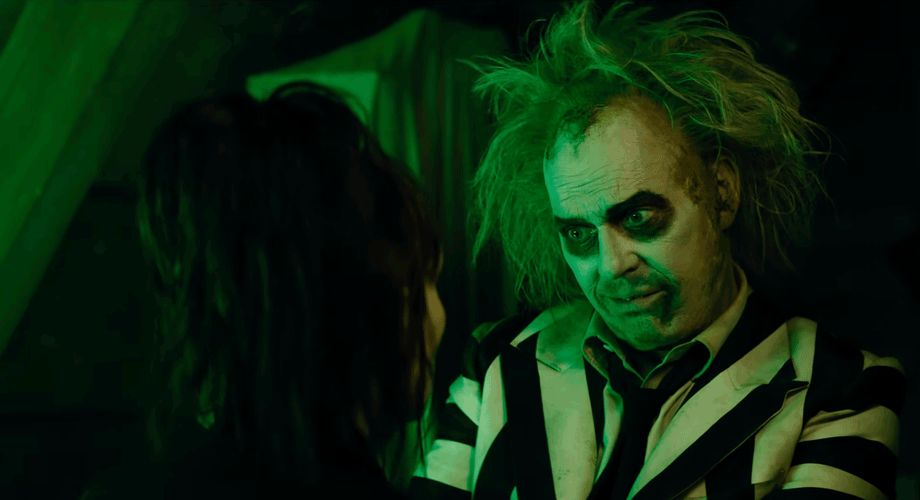
Tim Burton’s Beetlejuice movies show how screenwriters can successfully combine genres, in this case horror and comedy, by creating a unique and consistent tonal world.
Screenwriting Takeaway: Tonal Consistency
The original 1988 film, and its 2024 sequel, demonstrate that you can take risks with tone as long as your script’s “rules” are clear and consistent, no matter how bizarre.
- Classic Foundations: Underneath the strange visuals and dark comedy, both films are essentially a classic story or, well, family drama. The sequel, Beetlejuice Beetlejuice, is crafted as a mother/daughter love story dealing with grief.
- The Power of Simplicity: Director Tim Burton is “always trying to simplify” the story, which is “the essence of a classic filmmaker”. This directorial vision means the writers must have a strong, simple dramatic core to ground the weirdness, even if the cinematic frames look “wild and crazy”.
- The Family Drama First: For sequel screenwriters Alfred Gough and Miles Millar, the key was making sure “the family drama has to work regardless of all the ghost stuff”. They focused on the characters, asking: “How do we build a story that honors what Beetlejuice is? Usually there’s a ghost story and there’s always a family drama in the middle of it, and then there’s a satire”. Source: TheWrap, “How ‘Beetlejuice Beetlejuice’ Writers Alfred Gough and Miles Millar Brought the Franchise Back to Life”
- Visual Writing and Architecture: Screenwriter Miles Millar describes the process with Burton as highly visual. Their goal is to be “very visual writers and that if you read our scripts, you hopefully see the movie in the writing”. They first established an “architectural framework” or strong “spine” through a robust outline, and only then slotted in the “fun elements” and “set pieces”. Source: Creative Screenwriting, “Screenwriters Alfred Gough & Miles Millar Talk “Beetlejuice Beetlejuice””
- Essential Needle Drops: The films are famous for their musical interludes (like the “Day-O” sequence). The sequel’s writers made sure that the music cue—even one as “bonkers” as a seven-and-a-half-minute song—was “organically woven into their screenplay” and served a function to underscore the tone or possess humans.
The Core Story Always Wins
This Halloween, as you watch these films, look beyond the jump scares and gory scenes. Study the underlying structure, the character dynamics, and the precise way the screenwriters built their scary, compelling worlds.
Happy Halloween 🎃

You must be logged in to post a comment.