 Skip to content
As a screenwriter, you know this problem all too well: you’ve written your script, probably made several revisions, and now you’d like someone with more experience to proofread your script and give you good feedback. Of particular importance to you, of course, is constructive feedback: what works well in your storytelling? What should you improve? What should you delete? And how can you best make these changes without altering your entire story?
And if you ever had one, you know that it costs $150-250 and you’re often dissatisfied with the feedback, perhaps because it’s not detailed enough or the suggestions for improvement don’t fit your story. Not to mention that you have to wait 1-2 weeks for feedback that may disappoint you. 🤷♂️
Still relatively new to the digital world, there are now other options that not only save you time and money, but can also give you more neutral, unbiased feedback, and as you might have guessed, these are AI-powered screenplay analysis tools.
If you’re thinking, “Oh no, not AI again. What good will that do for my script?” Hold on, please stick with this article for a little longer and see if we can change your mind. Or take a look at some free coverage reports right away.

One of the greatest advantages is speed. The days of waiting weeks for feedback are over. AI-powered script analysis can provide comprehensive feedback within hours, often even on the same day. This fast turnaround allows you to maintain your creative flow so you can move straight on to the next draft.
These tools are also remarkably inexpensive. Hiring a professional script consultant can be costly, as mentioned earlier, but AI-powered services offer a fraction of the cost. As an example, our own script analysis starts at just $65/month and even offers you the option of having two scripts analyzed.
It’s interesting to know that AI offers you a neutral perspective. It analyzes your script based on objective data and proven storytelling principles, free from personal preferences, personal opinions, or unconscious biases. The feedback is purely analytical.
Using AI: We Analyzed The Social Network
Let’s look at a specific example. To demonstrate the power of these tools, we analyzed a well-known, award-winning screenplay: Aaron Sorkin’s “The Social Network.” This film, which follows the founding of Facebook, is regarded as a modern masterpiece of screenwriting and is celebrated for its excellent dialogue and unconventional narrative structure.

Script Score
Character Development: The main characters of Mark Zuckerberg, Eduardo Saverin, Cameron and Tyler Winklevoss, and Sean Parker are well-developed with distinct personalities and motivations. Their character arcs and relationships are central to the plot. However, some of the minor characters, like Christy and Erica, feel less developed.
Emotional Engagement: The tumultuous relationship between Mark and Eduardo is the emotional core. The audience feels sympathy for Eduardo and has a complex reaction to Mark. The high stakes keep things gripping.
Dialogue: The dialogue effectively captures the tech culture and Harvard lingo. The quick back-and-forth exchanges move the story along briskly. Eduardo and Sean have some particularly sharp dialogue. However, the legal deposition scenes slow down the pace.
Opinion: This whole screenplay feels like a whirlwind where everything is moving a mile a minute, and in contrast, the legal deposition scenes are like a breath of fresh air. You get a second to relax, not to mention some of the hardest-hitting dialogue in the film comes during these litigation scenes.
Overall Rating: 8 out of 10. In summary, it is a sharply written, relevant, and emotionally compelling story. The technical dialogue and legal scenes may present a small barrier for some mainstream audiences, but the quality of the writing and filmmaking should elevate the material. Based on the script score, this screenplay ranks at the 88th percentile and received a “Strong Consider.”
Thought: One of our favorite things about this script is how many screenwriting rules it breaks 😆. It just goes to show you that it doesn’t really matter how you write it, as long as what you write is clear and undeniably great.
Plot Assessment and Enhancement
What’s Working Well:
↳ The characters are well-defined, especially Mark, Eduardo, and Sean. Their contrasting personalities and goals lead to dramatic conflicts.
↳ There’s a good balance of technical business details with interpersonal relationships and drama.
↳ The legal deposition framework is effective.
↳ The writing has sharp, clever dialogue that reveals the tensions between the characters.
↳ The early conversation in the bar between Mark and Erica is a standout scene.
Opinion: Great notes, we agree. We love the opening setup scene with Mark and Erica. It highlights Mark’s obsession with status and exclusivity and sets the fast-paced tone for the rest of the script as Mark’s thoughts bounce from one to the next, keeping you off-beat and on your toes.
Areas for Improvement:
↳ While compelling, the plot feels dense at times. Additional passes could tighten certain scenes and smooth out the pacing.
↳ The legal disputes, while thematically essential, feel a bit mechanical in their execution. Making them more engaging and less dry could help.
Our Conclusion:
When a script is this good, any suggestions for improvement will really just be grasping at straws, though, we wouldn’t say we particularly agree with either of these. This story is incredibly tight and a masterclass at pacing. And again, with the legal scenes being some of our personal favorites. But at the end of the day, our tool is required to make some criticism, and these are the things that apparently stuck out.
Also included in our coverage service is a logline, a synopsis, a comprehensive synopsis, character profiles for Mark, Eduardo, Sean, and the Winklevoss twins, main character casting suggestions on a varied budget, and a list of comparative films to watch to draw inspiration.
Again, obviously in this instance, The Social Network is the most similar movie to itself, but if you were to upload an original screenplay, all the movies would subsequently be unique and pertaining to yours.
Additional Features That Will Enhance Your Script
Some AI tools provide more than just script analysis, such as the ability to edit the script directly after receiving feedback, asking more in-depth questions, having the AI perform proofreading, or options such as financial forecasting or film budget breakdown.

Follow-Up Questions
Once you receive your Greenlight Coverage report, you can use our Follow-Up Questions feature to ask more detailed questions about your feedback. Our AI provides explanations and more detailed information, taking into account the entire context of your script and the initial analysis. The best part is that it works like a live chat; you don’t have to wait for your answers—you get them instantly.
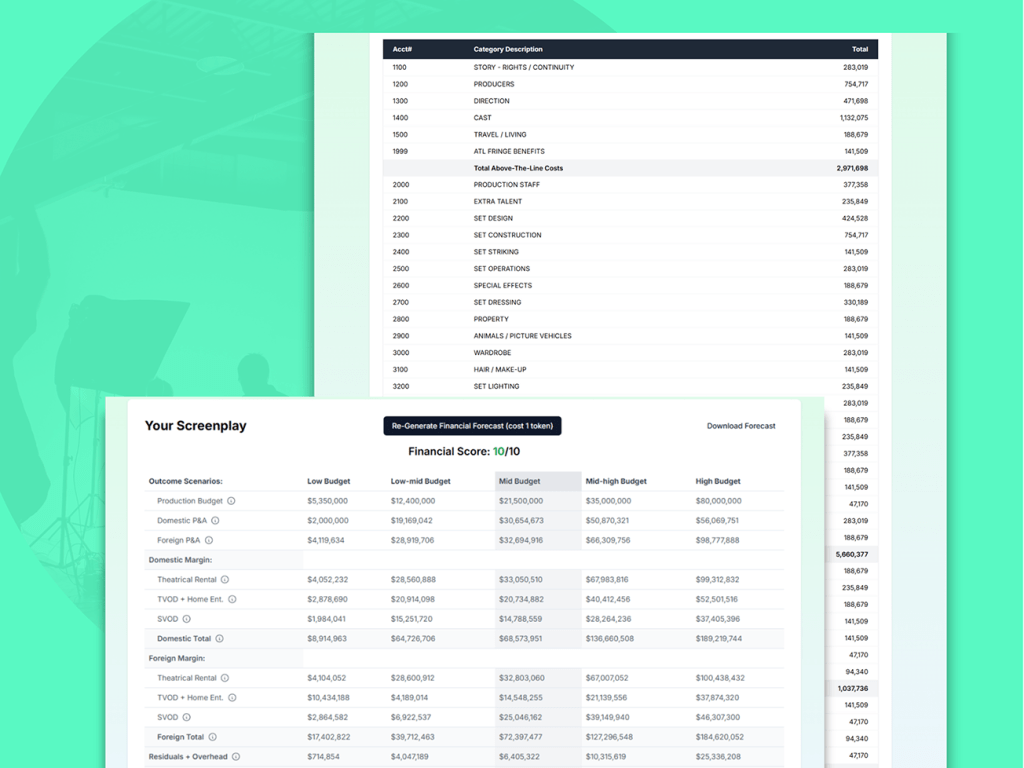
Film Budget Breakdown and Financial Forecasts
Our own film budget breakdown tool is a feature that allows you to create a detailed cost analysis for your film projects. By providing us with specific details about your film, you will receive a customized budget overview that breaks down various cost categories.
And our financial forecasting feature provides a detailed profitability forecast for your screenplay, helping you make informed decisions about the financial viability of your project.
Thank you for staying with us until the end of our article 🎉
We hope we’ve been able to give you a good insight into the advantages of AI screenplay analysis and that, even if you were skeptical at first, you might now be willing to give this option a try.
If so, use our promo code 5OFFNOW to get a 5% discount on your first month. Check out our pricing page and compare which subscription suits you best. And the best part is, if you’re not satisfied, we’ll even give you a full refund within the first month.
Keep writing your script, you’re doing great!
The Greenlight Coverage Team

You must be logged in to post a comment.